
Zoya Tandon
Class of 2028 · Edgemont High School · New York
09.18.2026
Why I Created Five Card Flow
Why do excited kids quit weeks after their first guitar lesson? The problem is that first lesson.

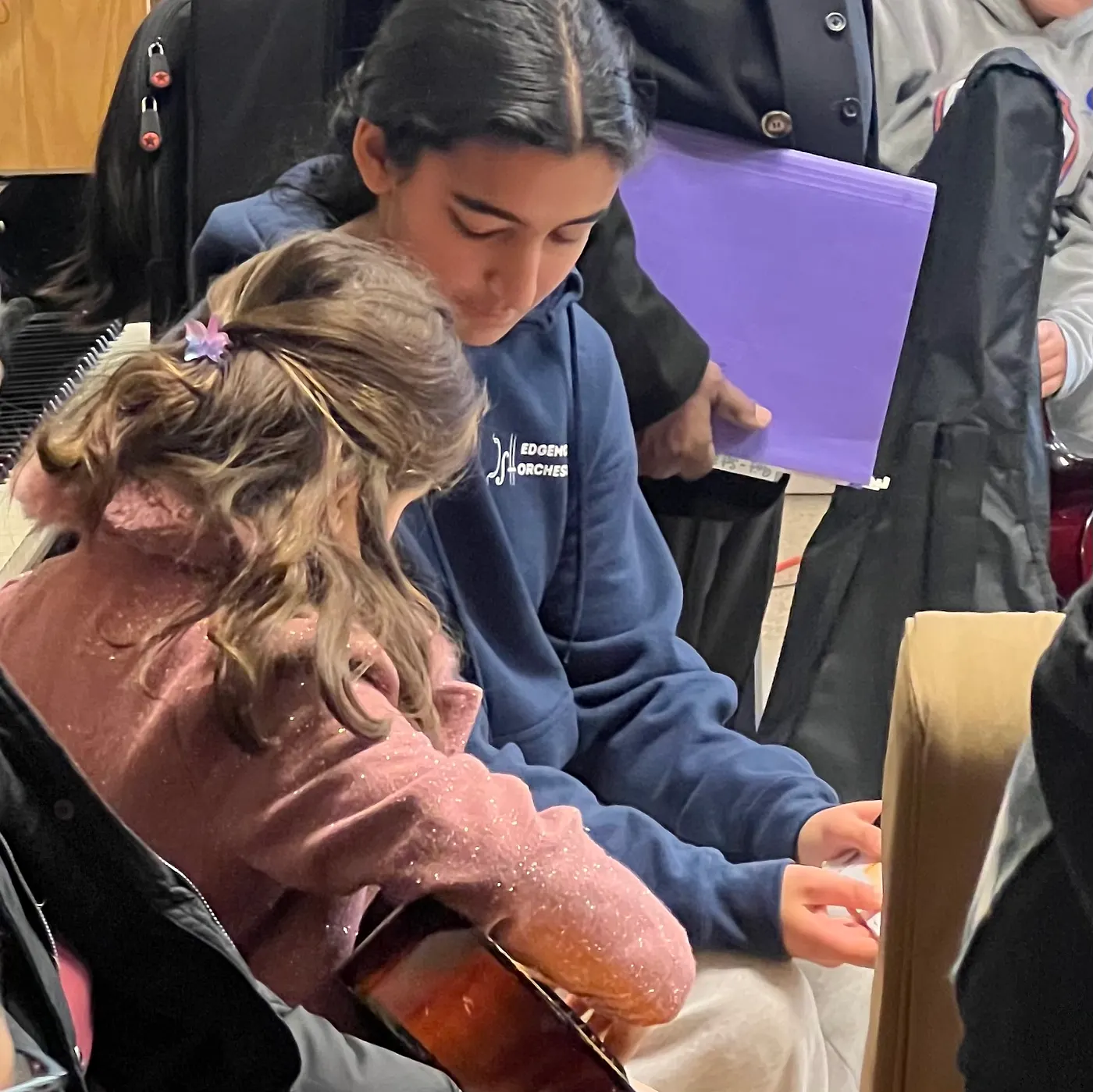
Elena is vibrating with energy, strumming wildly. We're ready to rock and roll at our first guitar lesson together.
The standard lesson begins and, five minutes in, she's stretching her little fingers to make a G-chord shape. When she finally gets them close enough and strums, the sound comes back dead — a thud and some buzzing. She tries again. Thud. I move her fingers a little. She tries again. Buzz.
She gives me the guitar. "I don't think I'm good at this."
She's eight years old and has only been playing for a few minutes.
I say the things guitar teachers always say. Everyone struggles with G at first. You just need to practice. Keep trying. She looks defeated.
Elena came back the next week, and the week after that, but the light was gone. A few weeks in, she stopped showing up at all.
She wasn't the only one.
I teach private lessons to kids in my neighborhood. They have families who care enough to pay for lessons, have their own guitars at home, and consistently have my full attention for 30 minutes. I also volunteer as a guitar teacher at Songcatchers, an after-school program in New Rochelle with students like Elena. Songcatchers students share communal rented guitars and get a lesson from whichever volunteer teacher happens to be around.
Different circumstances with the same result. It isn't money, instruments, or attention. Excited kids quit weeks after their first lesson. The problem is the lesson, not the kids.
I started Googling. The CEO of the guitar brand Fender said their research showed that 90% of first-time guitar players quit within a year. I was seeing it happen much sooner with my kids.
I thought about my parents' spice business. If 90% of customers threw the blends out after one use, we wouldn't blame the customers. We'd fix the recipe.
I didn't know how to fix this one.
In January 2026 I had ankle surgery for a soccer injury and missed six weeks of school. I sat on the couch with ice packs doing tedious rehab exercises and mindlessly scrolling on my phone. My dad handed me a book called This Is Your Brain on Music by Dr. Daniel Levitin. He thought I'd like it since I was interested in music and was teaching guitar. I figured it would be boring, textbook-y science stuff.

It wasn't.
Dr. Levitin explains that the brain is constantly predicting what comes next. When you hear the first three notes of a song you already know, your brain fires up expecting the fourth. When that note arrives exactly where you predicted, your brain releases dopamine — the same chemical you get from tasty food or winning a game. It literally rewards you for being right.
I realized traditional guitar teaching accidentally trains the prediction to run the other way.
When a kid's fingers hurt from straining to play a chord, their brain predicts: "This will keep hurting." And it does. Prediction confirmed.
When they make a sound that's objectively bad — buzzing, muted strings, nothing remotely musical — their brain predicts: "This won't sound like music." And it doesn't. Prediction confirmed.
By the time their fingers are strong enough and their muscle memory is developed enough to actually make music, most have already quit.
I'd been watching my students learn to predict failure in their very first lesson. Dr. Levitin's explanations sent me back to my own first lesson.
I was seven when I started playing guitar and, looking back, I probably should have quit too. But I didn't. Why? Because I had a wonderful teacher named Grace who didn't make me eat musical vegetables in the first few lessons.
No boring scales. No complex music theory. She didn't make me do drills that my second-grade fingers couldn't handle. Instead, she taught me "one-finger" chords — cheat codes, basically — that let me skip the frustration and get right to the reward: making a sound that felt like the real songs I loved. By the third week, I wasn't just a student practicing hand shapes; I was improvising and writing my own songs.
To this day, "Sheep Eating Bacon" is my best original song and it was written in the first 10 minutes of my first lesson with Grace.
That early burst of "I can do this" energy is the main reason I'm still playing guitar today. I never learned to predict failure, so it never occurred to me that I could fail.
Grace knew exactly what she was doing. I just never thought about it as a method until I read a book that described the problem she'd already solved for me.
Grace was a guitarist, and the whole thing worked because she was in the room with me. While I'm in the room with my students too, I wanted this method to be something that could work without me if needed. I decided I'd make simple cards, videos and an instruction guide to help more than just the students I could sit with.
I called it Five Card Flow.
I started sketching on index cards, trying to take what I remembered Grace doing and make it organized enough to use with a lot of different students. I was solving two problems at once. The chord shapes had to be easy for a child's hand. And the student had to feel like they were creating the music, not following along. Most beginner methods solve one of these and ignore the other.

I chose four chords in the key of G: G, C, E minor, and Dsus4, and created a colorful card for each one. Three of them take one finger. Dsus4 takes two, on adjacent strings at the same fret. Nothing in the set requires a stretch. The ring finger anchors on the third fret of the high E string and stays there through the changes, so there's less for a student to track — and it isn't a throwaway shortcut. That finger is already part of the full G chord. The kid is learning the first third of the real thing.

Choosing four chords that share a key isn't enough. The student decides the order, which means they also decide where the song ends — so every chord has to sound finished if you stop on it. Most chords in a key don't. The diminished one sounds unstable anywhere you put it. And D, which is the most useful chord in G and the hardest one to give up, leans. It wants to resolve back to G. A kid who happens to end there ends on a question mark.
I could have left D out, but it's too useful to lose. So I changed one note inside it instead. Take out the note that creates the lean and replace it with the one a step above, and you get Dsus4 — still useful, but no longer pulling anywhere. It comes out neither major nor minor, which is part of why it sits just as comfortably next to the other three chords.

I created a fifth card called the Solo Card that works the same way. The four notes on it aren't a scale shape I picked because it sounded nice. They're notes already living inside those four chords, which is why nothing a student plays can clash. Two of them are open strings, so a student with no hand on the neck can already play half of it.
The first time I used Five Card Flow was that spring, on a Saturday morning at Songcatchers — where the kids come when they can and usually get whichever volunteer teacher is around that week.
Marcus was seven, in his second lesson, already looking like he was done.
"We're going to write a song today."
"I don't know how to write a song."
"Yeah, you do. Pick a color."
Green. Red. Yellow. Blue. I showed him where each finger went. The anchor stayed put. Only two fingers moved, so he could hold all four in his head.
We played through it. Not perfect. But it sounded like something you'd hear on the radio.
"That sounds like a real song."
"That's because it is. You wrote it."
Then I handed him the Solo Card and told him there were no wrong notes. He played one. Then another. Then he was moving faster, making up a melody over a progression he had composed two minutes after not being able to play a chord.
His mom came in early to pick him up. She stopped in the doorway.
He kept going, grinning, not looking up.
She pulled out her phone and started recording.
After I created the first version of Five Card Flow, I wrote to Dr. Levitin to thank him for the book. He wrote back and suggested an open tuning: DADF♯AD, where the open strings give you D major and a barre at the fifth fret gives you G.
I tried out his idea over the summer at Songcatchers.
It worked in specific lessons but failed practically. My students see a different volunteer each Saturday. A kid who learned shapes in open tuning came back to a standard-tuned guitar and a different teacher, and the same fingers made completely different sounds. Their confidence dropped, and the exact frustration I'd designed against came back.
Dr. Levitin was solving for adults, one at a time, on an instrument that stays the way you left it. I'm solving for eight-year-olds who get a different teacher every week and often a different guitar.
I’ve taught around forty kids at Songcatchers so far with attendance that turns over constantly, so I don’t have real retention numbers. I do know that the first lessons go differently than they used to. Kids play something recognizable right away and are visibly surprised that they sound good. Parents mention their kids bringing it up at home. That's observation, not data, but it's a real change from before. Of the neighborhood students I've taught since I started using Five Card Flow, about half have stayed with guitar and gone on to study guitar with adult music teachers.
Over time, I want to gauge whether a kid who learns the one-finger G moves to full shape or hits a wall. I want to see if a student will continue improvising on their own with my videos or with another guitar teacher.
Most of all, I want to help other guitar teachers (and non-guitar-playing music teachers) give good guitar lessons to their own students so they want to continue playing.
Everything needed to use Five Card Flow is free and easily accessible — chord and solo cards, instruction guide, recordings of all 24 progressions – on fivecardflow.org. Since Five Card Flow is a work-in-progress, I love hearing from people who’ve tried and have suggestions to make it better. You can always email me at [email protected].
01.11.2026
The Invisible Work
I’ve been playing soccer for 10 years. Reading Moneyball while injured made me think differently about how I should play when I'm back on the field.

There's a specific kind of magic in the slow-motion replay of a soccer goal. For me, that moment brings a rush of excitement that never gets old, no matter how many times I’ve seen it. The replay traces back to the first player to touch the ball in that play and the commentator notes, “That ball started all the way back from behind the midfield with a great ball in from…” The camera cuts to the final shot of the ball hitting the back of the net and then the scorer celebrating as the crowd erupts.
The fans are on their feet, jumping up and down, waving their arms, proudly showing their team flag and colors, screaming and cheering for the goal scorer, as they should be — goals win games. But when I watch the replay, I love seeing the way the play builds up from the back and the pass that first breaks the line of pressure, or the timing of a perfectly played ball keeping the forward onsides and then the goal. For most casual fans, the game is exciting in the most obvious moments. Goals, top goal scorers, or goalkeepers and great saves. These are the clips that end up as highlights on social media and YouTube.
But there’s so much else happening in the game that doesn’t get as much attention. It is the spacing, off-ball movement, defensive work in the attacking half, and positioning that opens up the rest of the field. These are the small details that shape every possession but never end up on the stat sheet.
I never truly appreciated these details until I suffered a terrible ankle injury in a soccer game playing left wing with my club team. I planted my foot to block the ball, but my ankle gave way with a sudden pop. The pain was blinding. I remember blacking out as the voices of my coach and teammates drifted into the background. I was sidelined for months, facing surgery.
As I sat on the bench for weeks, watching my teammates continue to bond and play, a feeling of invisibility crept over me. It was hard watching from the bench, feeling useless because I couldn’t contribute to the game. Because I was forced off the field, I had more time to think about what actually happens on the field.
During these long hours of post-surgery recovery, I was desperate for some connection to sports. My dad gave me the book Moneyball by Michael Lewis. While the book is focused on baseball and statistics, it reveals what “real value” is. The book described how baseball scouts, for decades, ignored players who contributed to winning in “unsexy” ways like getting walked. Instead, the players they sought were the ones who hit home runs and looked the part.
We all celebrate the big finish but ignore the process and effort that makes that finish possible.
The book made me realize that casual fans (myself included) suffer from the same bias as the baseball scouts. We all celebrate the big finish but ignore the process and effort that makes that finish possible.
I’ve been playing soccer for 10 years and Moneyball made me think differently about how I would approach the game. I play left wing and I used to think that, because I was in the front line, I had to score a lot of goals to be considered a valuable player. I felt the pressure to be the star the fans cheer for.
Lying on the couch with an ice pack wrapped around my ankle while watching NWSL and USWNT games, I started to realize that the value wasn’t just in the final strike. It was in all the passes, dribbles, and runs that were happening before the goal.
Sitting on the living room floor moving an orange band side to side tediously with my ankle, watching the Portland Thorns, I began to see the game’s flow dictated not by the scorers, but by the midfield. I watched Sam Coffey. While the camera is following the ball, Coffey is constantly scanning and adjusting her positioning by inches in a way that will open up a passing lane for her teammate, throwing the defense off. She manages the tempo of the game by organizing plays from deep, allowing the forwards to shine.
My impact on the play needs to start 2–3 passes before the final strike.
In Moneyball, the Oakland A’s found their flow by getting on base and avoiding an “out.” In soccer, this invisible work means constantly scanning the field and looking for open space. It means positioning myself in a way that carves out a lane for a player to make a run. It means knowing when to check in, when to stay wide, or when to make a run. My impact on the play needs to start 2–3 passes before the final strike.
One goal can turn a tie into a win, or a close game into a comfortable lead. That shift doesn’t come entirely from the moment the ball crosses the goal line. To me, the real shift comes from the unseen aspects of the game. The tempo and discipline of spacing and positioning. The selfless off-ball movement. The breaking of a defense down from quick passes and smart plays.
Goals are the result of this shift but they don’t tell the whole story. That story is in the discipline and the invisible work that is required before the fans see the ball soar into the goal and that’s why this change of perspective resonates with me so deeply.
Recovering from an injury requires unwavering discipline and invisible work. It is a tedious, unglamorous cycle of repetitive motions far away from the cheering crowds. But just like an off-ball run that creates space for the striker, value is created in silence. I am doing the work the spotlight never reaches. The goal isn’t just to get back on the field, it’s to return as the player who makes the goal possible, long before the crowd knows to cheer.